

Christians believe the gospel “is the power of God for salvation to everyone who believes” (Romans 1:16, ESV). But what do Christians mean when they say the “gospel”, “the gospel of Jesus Christ”, or “the gospel of God”? The “gospel” means “good news”. More specifically, the gospel is the good news about Jesus!
The apostle Paul tells the church in Corinth, “For I delivered to you as of first importance what I also received: that Christ died for our sins in accordance with the Scriptures, that he was buried, that he was raised on the third day in accordance with the Scriptures” (1 Corinthians 15:3-4, ESV). Make no mistake, the gospel is about Jesus. But what makes this good news has to do with how Jesus’ works and personal righteousness is applied to sinners like you and me.
- Do we need to be perfect in order to merit the righteousness of Christ?
- Do we need to accomplish some task in order to become worthy of what Jesus has done for us?
- Do we need to clean ourselves up first before we come to Jesus for salvation?
- Do we need to be baptized or join a church before we can be saved?
These questions can be answered by understanding five biblical truths that are at the heart of the gospel message itself. How so? Because in understanding these five truths, we understand how Jesus’ sinless life, substitutionary death, resurrection from the dead, and ascension to reign at the Father’s right hand is of benefit to you and me.
We understand what makes the news about Jesus good!
The Heart of the Gospel
At the heart of the gospel are five essential truths often summarized by what is referred to as the “Five Solas”, Latin phrases that declare the following:
- Sola Scriptura (Salvation is according to Scripture alone)
- Sola Gratia (Salvation is by grace alone)
- Sola Fide (Salvation is through faith alone)
- Solus Christus (Salvation is in Christ alone)
- Soli Deo Gloria (Salvation is to the glory of God alone)
Salvation is according to Scripture alone: The gospel is an audible message about Jesus. You may have heard this common slogan, “share the gospel, and if necessary, use words.” This is not a biblical slogan. As Christians we ought to display the gospel in our lives by sharing the love of Christ, but the gospel itself is not a deed done for our neighbor, it is an audible message that requires us to use words and open our mouth. Furthermore, if the gospel is an audible message about Christ, where do we receive the content of this message? The answer is the Bible. The Bible alone is the source of objective, inerrant, and authoritative truth (2 Timothy 3:16; 2 Peter 1:20-21). Thus, the gospel is sharing the message or word of Christ that we receive in the Bible. The gospel is not a message we make up on our own. We do not own the gospel, God does. Therefore, we do not have the right to make up our own version of the gospel. We must go to the Scriptures to discover the message we are commanded to share. The Bible says that faith comes from what is heard (Romans 10:17), and what we hear is the word of Christ. The means that what the Holy Spirit uses to regenerate and convert sinners to Christ is the gospel of God’s grace spoken audibly, not acts of charity. This is why we labor to get the Word of God out to as many people as possible so they can hear the word of Christ, believe the Scriptures, and be saved through faith in the biblical Christ.
“So faith comes from hearing, and hearing through the word of Christ.”
Romans 10:17, ESV
Salvation is by grace alone: Grace is receiving what you do not deserve. Biblically, it is unmerited favor from God. Therefore, salvation is by grace rather than works. Because all mankind has fallen short of the glory of God (Romans 3:23) and has transgressed God’s law (primarily summarized in the Ten Commandments), we are sinners in need of a Savior. Our sin problem is so deep and serious that it is rooted in our very nature as human beings (Psalm 51:5; John 3:19-20; Romans 3:10-18). This means that we cannot overcome our sinful nature on our own. We cannot save ourselves by trying to be a more moral person. No one goes to heaven because they were a “good person.” Church attendance, acts of charity, or any other deed cannot save a soul. The gospel is not a message of behavioral modification. Rather, the gospel is a message of divine transformation (2 Corinthians 5:17). Since we cannot save ourselves by our own works or deeds (Romans 3:27-28; Galatians 5:4; Philippians 3:9), God must grant what we cannot produce within ourselves, namely the faith necessary for salvation. Thus, salvation is not a work of man, but 100% a work of God (Psalm 3:8) and a gift of grace toward unworthy sinners (Ephesians 1:3-8, 2:8-9). Paul says to the church in Ephesus, “For it is by grace you have been saved through faith, and this not from yourselves; it is the gift of God, not by works, so that no one can boast.” (Ephesians 2:8-9).
“But God, being rich in mercy, because of the great love with which he loved us, even when we were dead in our trespasses, made us alive together with Christ – by grace you have been saved.”
Ephesians 2:4-5, ESV
Salvation is through faith alone: The gospel demands a response from all human beings, and that response is faith; faith that gives birth to repentance in our lives. Genuine faith always leads to a turning away from sin (Proverbs 8:13; Hebrews 10:26; 1 John 2:6). Faith and repentance are simultaneous gifts of grace at the moment of our conversion; they cannot take place apart from one another (Ezekiel 36:26-27; Ephesians 2:8-10). Furthermore, faith is not simply being a “spiritual person.” Genuine faith is faith in the life, death, and resurrection of the Lord Jesus Christ. Faith in Jesus justifies or declares one right with God (Romans 5:1). What is faith? The author of Hebrews tells us that “faith is the assurance of things hoped for, the conviction of things not seen“ (Hebrews 11:1, ESV). Thus, faith is deep personal trust in Christ. Faith is trusting in Jesus as you would trust in a parachute jumping from a plane 18,000 feet in the air; it is complete and total dependence upon the Lord. We are saved not in trusting our own works for salvation, but in trusting in the finished work of Jesus – His life, death, and resurrection as being sufficient for all time to save sinners who look to Him in faith (Hebrews 9:28; 1 Peter 3:18). Our rest as Christians is not in the strength of our faith but in the strength of the One in whom our faith is placed.
“For we hold that one is justified by faith apart from works of the law.”
Romans 3:28, ESV
Salvation is in Christ alone: Jesus is the only source of salvation and eternal life. Jesus is the way, the truth, and the life (John 14:6). Eternal life is in Christ and in Him alone, no matter our ethnic, geographical, economic, or religious background. The word “Christ” means “anointed one,” referring to anointing a king with oil when he is crowned. So, when we say “Jesus Christ,” we’re saying that Jesus is King! Only Jesus is an all-sufficient Savior because only Jesus is the mediator between God and man (1 Timothy 2:5). Only Jesus has perfectly obeyed the Law of God, fulfilling all of its requirements making Him a sufficient sacrifice for the sins of His people on the cross (Matthew 5:17). Only Jesus has atoned for the sins of His people, bearing the wrath of God the Father in our place as our substitute due to our sin through His death on the cross (Isaiah 53; Hebrews 9:12, 28; Revelation 5:9, 12). Only Jesus has been resurrected from the grave in victory and triumph over sin and death (Luke 24:6-7; Acts 3:15; Romans 8:34). Only Jesus sits at the right hand of the Father, reigning over the nations and awaiting His return for His bride – the Church (2 Corinthians 11:2; Ephesians 5:27; Hebrews 8:1; 1 Peter 3:22; Revelation 19:7). Only in Jesus the Christ are sinners saved and delivered from the guilt of sin, the power of sin, and one day soon at his return the very presence of sin.
“And there is salvation in no one else, for there is no other name under heaven given among men by which we must be saved.”
Acts 4:12, ESV
Salvation is to the glory of God alone: Because we are saved and kept by grace and not works, we have no room to boast in our salvation (Ephesians 2:8-9). The natural end of what we have learned thus far in salvation being through Scripture alone, by grace alone, through faith alone, and in Christ alone, is that our salvation glorifies not people but the God who is the author and perfecter of our faith (Hebrews 12:2). Glory does not belong to the recipients of mercy, but to the One who gives the mercy. The whole of the Christian life is seeking to make much of Christ because of the mercy we have found in Him by grace alone (John 3:30; Romans 12:1; Philippians 1:20-21). In the words of John Piper, “God is most glorified in us when we are most satisfied in Him.” What we satisfy ourselves in is our salvation that is rooted in the finished work of Christ, and in that God is glorified.
“Not to us, O LORD, not to us, but to your name give glory, for the sake of your steadfast love and your faithfulness!”
Psalm 115:1, ESV
How Do I Share the Gospel?
An easy way to remember the gospel is by memorizing the 3 circle method:
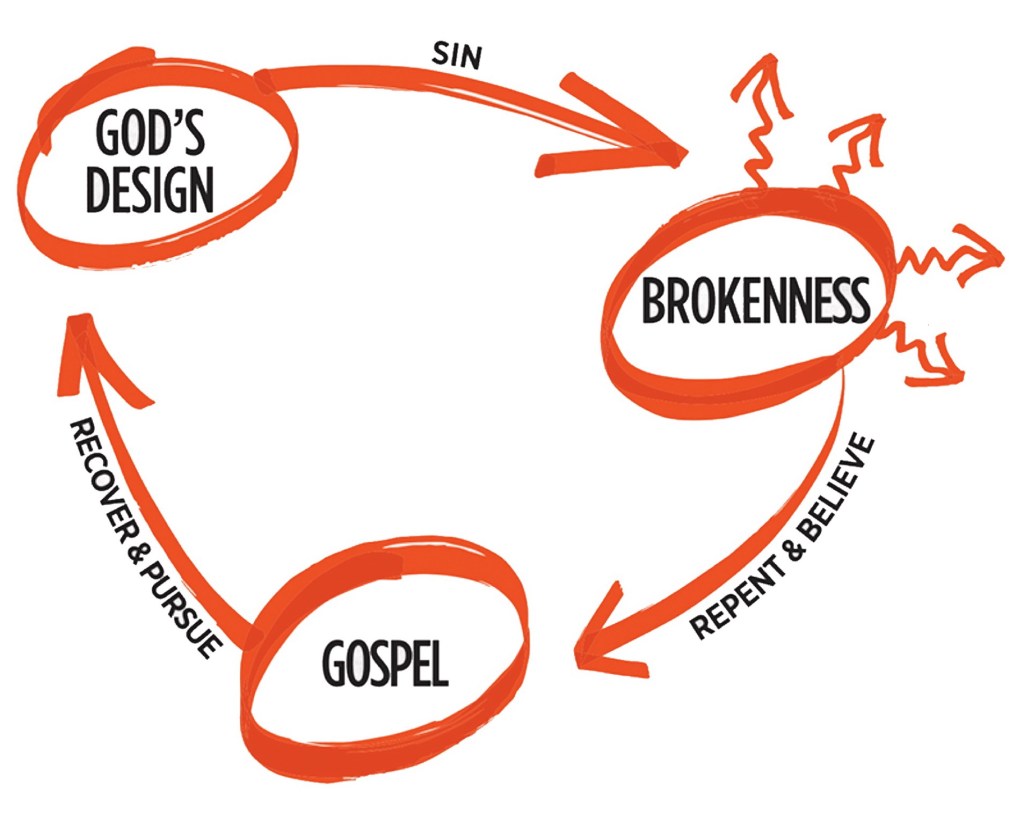
God’s Design: God created everything good, holy, and perfect. Humans were created to glorify God and to enjoy Him forever in perfect harmony. Unfortunately, sin entered creation through Adam’s disobedience in the Garden of Eden. Because Adam represented all humanity before God, all people are born in need of salvation. Our perfect relationship with God is now severed and we need delivered from God’s wrath and just condemnation as those who have sinned and broken His law.
Brokenness: Sin not only impacts our spiritual life but it is also the cause for our physical and relational brokenness as well. Because of sin, God’s design for creation is distorted by hatred, envy, gossip, slander, lust, pain, suffering, illness, and ultimately death.
Gospel: As sinners living in a fallen world, we need redemption. The good news of the gospel is that in Jesus alone, by grace through faith alone, we can find forgiveness and eternal life. What was lost due to sin can be fully restored! Jesus is the mediator that bridges the gap between holy God and unrighteous man. It is through repenting, turning away from our sinful desires, and believing in the death, burial, and resurrection of Jesus Christ that secures our deliverance not only from the guilt and power of sin, but one day soon the very presence of sin. Until our faith becomes sight, as Christians we seek to recover and pursue the purpose for which all people were made: to glorify God and enjoy Him forever.
 CCBC
CCBC 